Algal Blooms & Trace Contaminants Monitoring
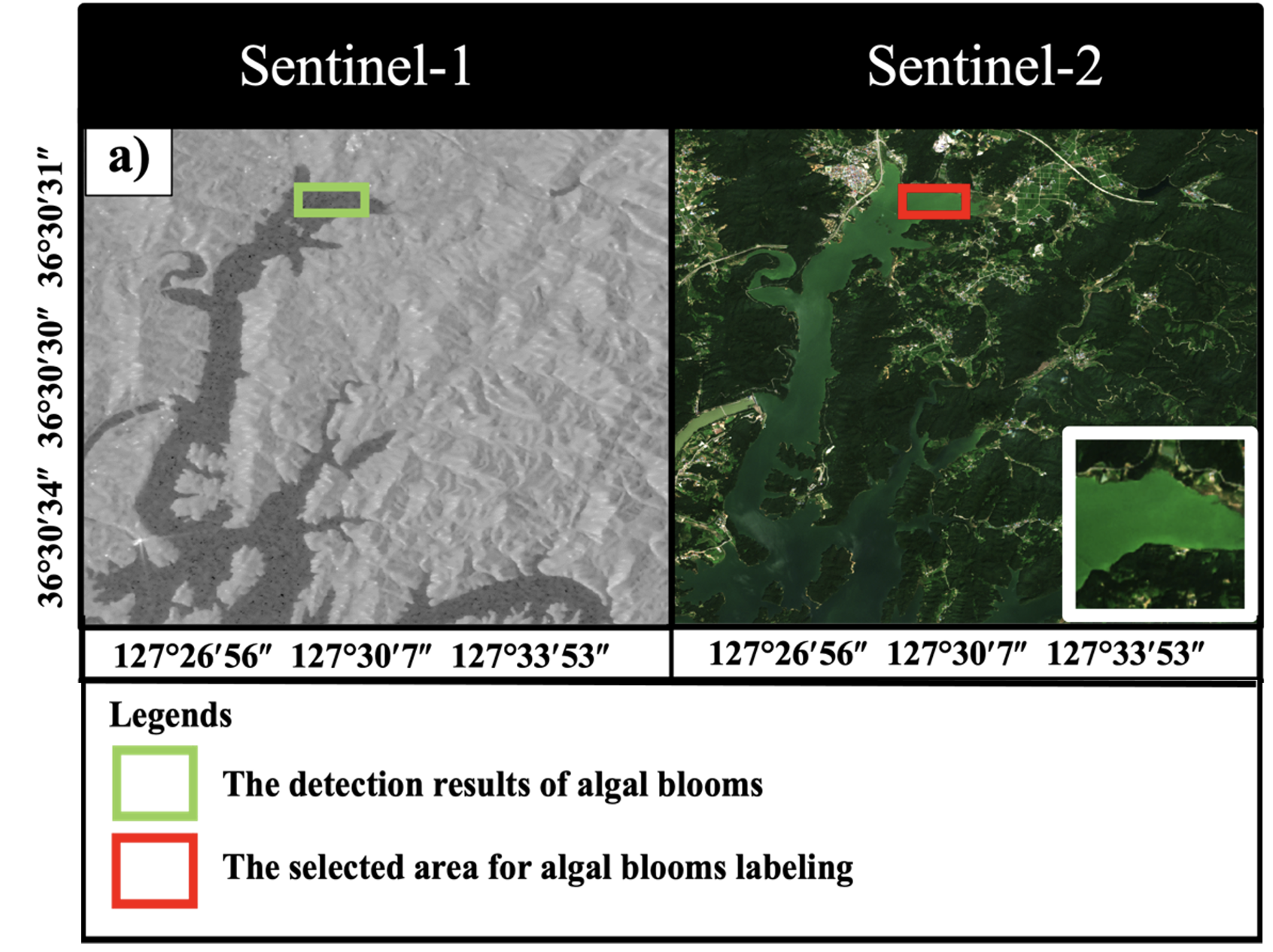
Deep learning-based algal bloom & trace contaminants detection using SAR imagery
Overview
Developed an AI-driven monitoring system for detecting harmful algal blooms and trace contaminants in water systems using Sentinel-1 SAR imagery and deep learning models. This research was conducted in collaboration with K-water (Korea Water Resources Corporation), with the primary study area focused on the Geum River basin in South Korea.
Research Context
At UNIST, I worked on implementing deep learning techniques on Sentinel-1 SAR imagery for precise change detection and localization of algal blooms & trace contaminants in Korean reservoirs.
Technical Approach
- SAR Image Processing: Utilized Sentinel-1 C-band SAR data for all-weather monitoring capability
- Deep Learning Models: Implemented Faster R-CNN for bloom & trace contaminant detection
- Multi-temporal Analysis: Developed algorithms for tracking bloom seasonality
- Multi-source Data Fusion: Combined satellite imagery with in-situ sensor data
Key Results
- High Detection Accuracy: Achieved bloom detection even under cloud cover conditions with a recall ~0.70
- Complementary Tool: Developed a complementary tool for monitoring blooms and the basic development of automatic detection algorithms.
- Published Research: Contributed to paper published in GIScience & Remote Sensing (Taylor & Francis)
Technologies Used
| Category | Tools |
|---|---|
| Deep Learning | PyTorch, Faster R-CNN |
| Remote Sensing | Sentinel-1 SAR, SNAP, GDAL |
| GIS | QGIS, GeoPandas, Rasterio |
| Languages | Python, MATLAB |
Publications
This research contributed to:
- SAR remote sensing for monitoring harmful algal blooms using deep learning models - GIScience & Remote Sensing, 2025